Join Natur&Foto on an epic journey to Churchill, Canada in October 2026. Here we will photograph polar bears on foot and at eye level. A unique and extraordinary polar bear experience!
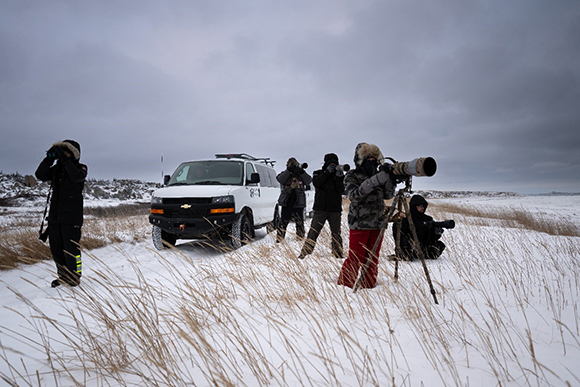
As many may have heard, there are now distance restrictions for polar bears in Svalbard. Until July 1, the minimum distance is 500 meters, and after July 1 it is 300 meters. This means you can forget about close-up shots of polar bears in Svalbard. Instead, we are heading to the main Canadian polar bear population in Churchill on Hudson Bay. Here we will drive in four-wheel-drive vans along tundra roads. When we spot a polar bear, we can step out of the vehicle and photograph on foot – at eye level – and at relatively close range. Experienced guides will be with us to tell us when to return to the vehicle.
We will have two vans, with six photographers in each. With such a small group, everyone has quick access to a van door if a bear approaches and we need to take cover immediately. It also allows us to quickly exit the vehicle if we spot an Arctic fox or a moving bear. The small group also provides flexibility to move around and choose better backgrounds or angles.
Our guide, Michael Bertelsen, has 15 years of experience leading photographers wanting to capture polar bears. Understanding bear behavior is key to success and safety. He has guided both National Geographic and BBC teams.
Polar bears are found throughout the Arctic: Svalbard, Greenland, Russia, Alaska, and Canada. They are divided into 20 distinct populations, totaling 20,000–25,000 individuals. About 3,000 of these live in Svalbard and Franz Josef Land, which forms one of these populations.
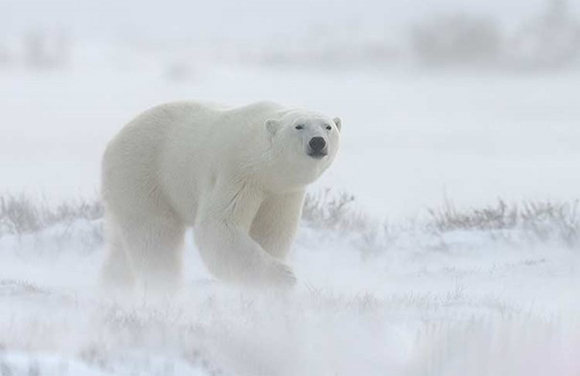
One of the southernmost polar bear populations is in Hudson Bay, Canada, at roughly the same latitude as Oslo. However, climate change is already affecting them. The ice in this large bay melts earlier in spring and forms later in autumn, meaning a shorter hunting season. When the sea ice disappears in June, polar bears remain on land. They may find some carcasses, eggs, or bird chicks, but this is a very lean diet compared to fat seal meals. The period on land is essentially a fasting period until the ice returns in November.
Pregnant females experience even longer fasting. They move inland in autumn to give birth. Only when the cubs emerge from the den in March do the mother and cubs return to the ice to feed on seals. By then, the mother has fasted for eight to nine months. For every week the ice breaks up earlier than usual, polar bears come ashore about 10 kilos lighter. Over the last three decades, the ice-free period has begun three weeks earlier. Pregnant females are therefore in poorer condition during gestation and have fewer cubs.
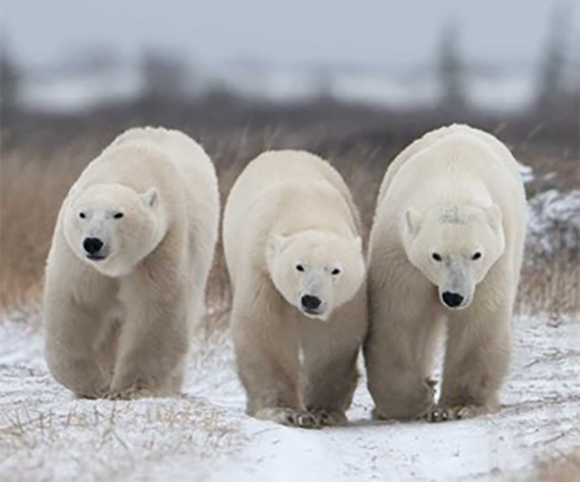
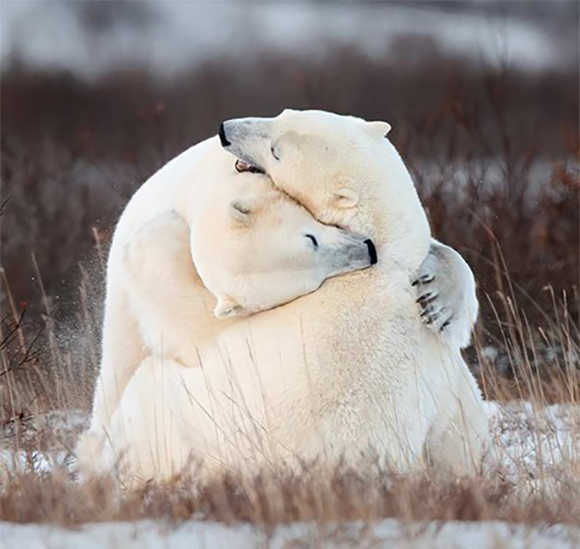
There are around 600 polar bears in this western Hudson Bay population – about half of what it was 40 years ago – but still nearly one bear per resident in Churchill. Occasionally, polar bears wander the streets, much like what foreigners once imagined of Tromsø. Yes, there is even a polar bear police force and a polar bear jail – and photographers from around the world come to experience this iconic animal up close. Most participate in so-called tundra buggies, large vehicles on the tundra, but photographers in those sit about three meters above the ground. We, however, drive vans and will be able to photograph at eye level – outside the vehicle – on foot.
We travel in late October/early November, when polar bears gather along the shores of Hudson Bay, waiting for the ice to form. This is therefore the best time to see them.
Accommodation
We stay at Churchill Lodge, exclusively for our small group of photographers. Quiet nights (no slamming doors or hallway chatter) ensure everyone gets a restful sleep. Each room has a private bathroom with a three-piece bath, a refrigerator, comfortable beds, and individual thermostats. There is a shared kitchen and common space for working on photos and sharing stories from the day.
Photo: Michael Bertelsen